
Repeat signs are the symbols of music notation that tell you to play a passage again or to jump to another place in the score. They save writing the same passage twice, and knowing how to read them is essential to follow the playing order of a piece. In each example on this page you can press ▶ to hear the real order in which it is played: not what is written, but how it sounds once the repeats are worked out.
Repeat barlines
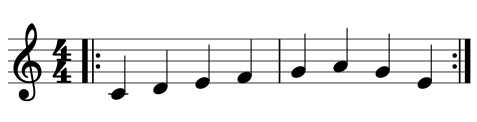
These are two dots next to a double bar line. The opening repeat sign |: marks where the repeated section begins, and the closing one :| marks the end. At :| you go back to |: (or to the beginning, if there is no opening sign) and play the passage a second time.
First and second endings
When a repeated section ends differently the first and second time, endings are used (UK: first- and second-time bars, also called volta brackets): a bracket with the number 1. over the end of the first pass and another with 2. over the end of the second. You play the common part and the first ending, go back to the start, play the common part again and, this time, skip the first ending and go straight to the second.

Da Capo (D.C.) and Fine
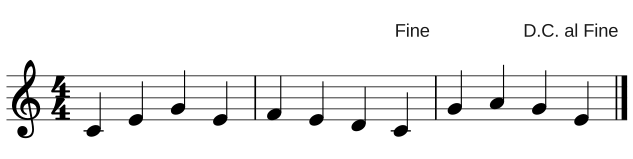
Da Capo means "from the head", that is, from the beginning. At the marking D.C. (or D.C. al Fine) you go back to the start of the piece and play again until the word Fine ("end"), where you stop, even if more measures are written after it.
Dal Segno (D.S.), the Segno and the Coda
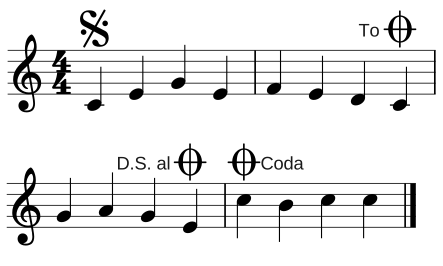
Dal Segno means "from the sign". At D.S. you go back, not to the beginning, but to the sign (segno) placed earlier in the score. The Coda is a closing section: with D.S. al Coda, on the repeat you play up to the To Coda mark and from there jump straight to the Coda.
How do you read repeat signs? (playing order)
To avoid getting lost in a score with repeats, follow this order:
- Play normally until you meet the first repeat sign.
- Repeat barlines: at :|, go back to |: (or to the beginning if there is no opening sign) and repeat that section once.
- Endings: if there are first and second endings, play the first on the first pass. On the repeat, skip it and play the second.
- D.C. or D.S.: at a Da Capo go back to the beginning. At a Dal Segno, go back to the sign 𝄋.
- Fine and Coda: after a D.C. or D.S., you finish at Fine, or jump to the Coda 𝄌 when you reach the To Coda mark.
The order that confuses people most is D.S. al Coda: you play to the end, go back to the segno, repeat up to "To Coda" and jump to the Coda from there. You can hear this route by pressing ▶ in the Dal Segno example above.
Table of repeat signs
| Sign | Name | Meaning |
|---|---|---|
| |: | Repeat sign (opening) | Start of the section to be repeated. |
| :| | Repeat sign (closing) | End of the section; go back to the opening sign (or the start). |
| 1. · 2. | First and second endings | A different ending for the first and second pass. |
| D.C. | Da Capo | Go back to the beginning. |
| D.C. al Fine | Da Capo al Fine | Go back to the beginning and play until "Fine". |
| Fine | Fine | The point where the piece ends after a D.C. or D.S. |
| Segno | The point you return to at a "Dal Segno". | |
| D.S. | Dal Segno | Go back to the sign 𝄋. |
| D.S. al Coda | Dal Segno al Coda | Go back to the sign and, at "To Coda", jump to the Coda. |
| · To Coda | Coda / To Coda | Closing section, and the mark from which you jump to it. |
| bis | Bis | Repeat the marked passage (usually shown with a bracket). |
These signs organize musical form and rely on the structure of measures. To keep the beat steady while you read a score with repeats, practice with the online metronome.