
The metronome is the most useful practice tool a musician has, and the most feared. Used well, it turns uneven rhythm into a steady pulse, shows where you rush or drag without noticing, and lets you build technique at a speed you control. Used badly, it is just an annoying click in the background. This guide shows you how to practice with a metronome properly: the method of raising the tempo a little at a time, and a set of staff exercises you can start playing today. You can follow along with our online metronome.
What is practicing with a metronome good for?
A metronome gives a perfectly regular pulse at the speed you choose, measured in beats per minute (BPM). Its value is not in "playing along with a click" but in what the click teaches you:
- It builds your inner pulse. Over time you absorb the regularity and stop needing the click.
- It exposes your unsteady spots. The places where you drift away from the click are exactly the places to work on.
- It lets you build speed safely. You lock in a passage at a slow tempo and speed up in controlled steps, without practicing mistakes.
- It trains subdivision. You learn to place notes exactly inside each beat.
The key principle: start slow and raise the tempo gradually
Almost all effective metronome practice comes down to one idea: play cleanly at a comfortable tempo, then increase the speed in small steps. The most common mistake is to jump straight to the target tempo. You make errors, and the errors get memorized.
The routine is simple:
- Set the metronome to the fastest tempo at which you can play the passage without mistakes or tension. That is your real starting point.
- When you play it cleanly two or three times in a row, raise the tempo by 2–5 BPM.
- If mistakes appear, drop back 5–10 BPM, consolidate, and start climbing again.
Our metronome automates exactly this with its Speed Trainer: you set a start BPM, an end BPM and how many measures (UK: bars) pass between increases, and the tool speeds up on its own while you concentrate on playing.
Exercise 1: one scale in different rhythms
This is the king of metronome exercises, and it works on any instrument. Take a scale you already know and repeat it with different rhythmic patterns, always keeping the same tempo on the metronome. What changes is not the speed of the click but how many notes fit in each beat. That trains subdivision and evenness between notes.
We will use the C major scale in 4/4. Set the metronome to click the quarter note (UK: crotchet), starting around 60 BPM, and play each pattern without stopping between them. Each one fills exactly one measure:
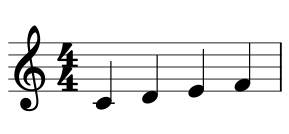
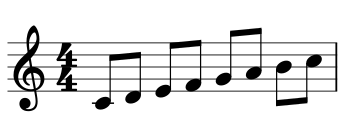
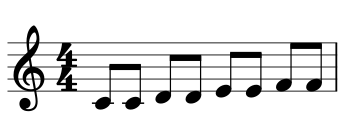
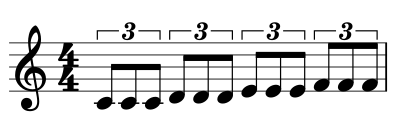
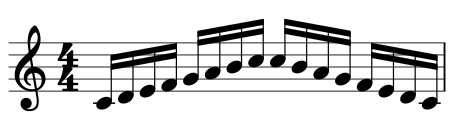
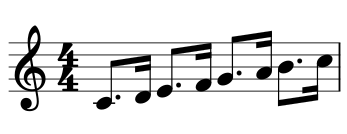
The examples are written in C major for clarity, but the goal is to practice them in every key. Once you have mastered a pattern and raised the tempo, repeat the same series of rhythms on other scales. You will find them all, with key signature and note-by-note fingering, in major scales and minor scales. Changing key while keeping the same rhythms is what turns this exercise into a complete technical study.
Exercise 2: the subdivision pyramid
This exercise trains the hardest skill: changing subdivision without changing the pulse. In a single measure of 4/4, each beat carries a different subdivision (a quarter note, two eighths, a triplet and four sixteenths) on one repeated note, so all your attention goes to the rhythm:
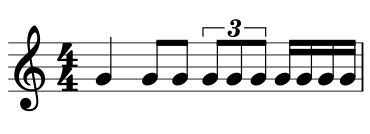
To understand more deeply how notes are distributed inside a measure, see the guide on how to analyze a time signature.
How to apply it to your instrument
The metronome is the same for everyone. What changes is what you apply it to:
- Guitar and bass: besides scales, work on chord changes. Start with one chord per measure (whole notes), then two per measure (half notes) and finally one per beat (quarter notes), so you shorten the change time step by step.
- Piano: practice the rhythms hands separately first, then together. The subdivision pyramid is excellent for evening out the two hands.
- Winds (flute, clarinet, saxophone, brass): use the same patterns, making sure each note starts exactly in its place. Watch your air and articulation, which is where regularity usually gets lost.
- Percussion: rudiments with a gradual tempo increase are the classic example; the pyramid trains clean changes between subdivisions.
- Voice: apply the rhythms to vocalises on the scale so you do not drag or rush the notes.
Common mistakes when practicing with a metronome
- Always playing at the same tempo. If you never speed up, you do not progress; if you speed up too soon, you practice mistakes.
- "Chasing" the click. You should not react to the metronome but anticipate it: the click confirms your pulse, it does not dictate it on the fly.
- Not subdividing at slow tempos. There is a lot of space between one click and the next; if you do not subdivide mentally, you drift.
- Leaving it on for the whole session. Alternate stretches with and without the metronome to check whether you have really internalized the pulse.
Practice with the online metronome
Our free online metronome has everything you need for these exercises: a Speed Trainer (raises the tempo automatically), subdivisions (quarter, eighth, triplet, sixteenth and more), customizable accents, a mute mode that trains your inner pulse, and several sounds, including acoustic temple block and claves clicks. Open it, set it to 60 BPM and start with the quarter notes.