
Games to train your musical ear. What counts here is what you hear. Notes or melodies play and you have to remember and recognize them, with no microphone: you play with your finger, the mouse or the keyboard. They are free, they run in the browser and there is nothing to install.
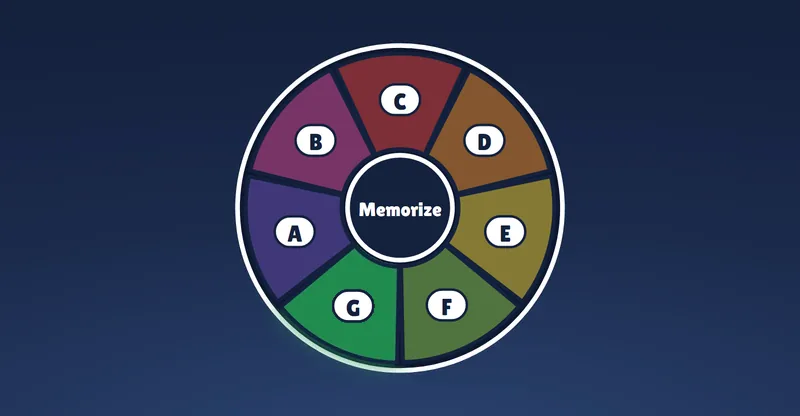
Memorize
The board plays a sequence of notes and you repeat it in the same order. Each time you get it right, it grows by one note; at your first mistake the game ends. On Easy each note has its color and lights up; on Medium it only lights up; on Hard you only hear it.
Play Memorize
Track Cycling
Race the kilometer: on each of the 4 laps a melody plays and you say whether it is in a major or a minor key. The clock runs until you answer, and every mistake is a 15-second bonk.
Play Track CyclingWhat these games train
Hearing a note and knowing which one it is, and remembering several in a row, is what you need for melodic dictation, for playing by ear and for learning a melody without a score. These games train it step by step:
- Auditory memory: hold on to a longer and longer series of sounds, in the exact order.
- Recognizing the mode: know right away whether a melody is major or minor, as in conservatory dictation.
- Recognizing notes by their sound: on the hard levels there are no lights or colors to help, only your ear.
- Progressing by levels: you start with visual aids (color and light) that are gradually taken away until only the sound is left.
Before you play
Turn up the volume or put on headphones: in a noisy place it is harder to tell the notes apart. These games do not use the microphone. Each game keeps its own leaderboard on your device and, if you want, a world leaderboard under your nickname.
If you would rather practice without a scoreboard, try the ear training exercises, such as Major or Minor?, recognizing the time signature or recognizing the key. If you prefer to sing, there are the singing games, and to practice with what is written on the staff, the music theory games.