
The saxophone has a unique advantage for the learner: its four members in the band and the orchestra, soprano, alto, tenor and baritone, are played exactly the same way. Same fingering, same writing in treble clef; the only thing that changes is how much each one transposes. On this page you will find their notes, the transposition of each one and how the family is organized.

| Family | Woodwind (single reed, metal body) |
|---|---|
| Pitch | E♭ (alto and baritone) and B♭ (soprano and tenor) |
| Transposition | Yes: it depends on the member of the family |
| Range | Written B♭3–F♯6 (the same for all four) |
| Mechanism | Keys (the system of Adolphe Sax) |
| Clef | Treble |
One fingering, four instruments
This is the key to the whole family: a saxophonist who can play the alto can already play all four. When you read a written C4 and put down that fingering, whichever saxophone you hold sounds its own note, but you read and finger the same thing. That is why doubling on several saxophones is so normal in a big band. All the notes on this page are written notes; the table below tells you what sounds on each member.
| Saxophone | Pitch | A written C4 sounds… | Sounding range |
|---|---|---|---|
| Soprano | B♭ | B♭3 (major 2nd down) | A♭3–E6 |
| Alto | E♭ | E♭3 (major 6th down) | D♭3–A5 |
| Tenor | B♭ | B♭2 (major 9th down) | A♭2–E5 |
| Baritone | E♭ | E♭2 (major 6th + octave down) | D♭2–A4 (C2 on low-A models) |
Notice the pattern: the saxophones in B♭ (soprano and tenor) and the ones in E♭ (alto and baritone) alternate, and each pair is an octave apart. It is the same transposition logic you saw with the clarinet and the bass clarinet. The sounding ranges follow from the written range B♭3–F♯6 minus each transposition.
How do the four saxophones differ?
If they share fingering and writing, what sets them apart is their size (and with it the pitch they sound) and the role each one usually plays:


| Saxophone | Size | Usual role |
|---|---|---|
| Soprano | The smallest; usually straight, like a metal clarinet | Bright, penetrating tone, often used as a solo voice |
| Alto | Medium, with the bell already curved | The most common; the reference in classical music, the band and teaching |
| Tenor | Large, with a hook-shaped neck | The great voice of jazz; warm, expressive sound |
| Baritone | The largest, with a characteristic loop above the mouthpiece | The low foundation of the sax section |
These are the four usual ones, but the family is wider. To see it complete, from the sopranino to the contrabass, with a scaled picture and a comparison table, visit the types of saxophone.
Range and registers
The standard written range is B♭3–F♯6, identical for all four (the sounding pitch changes with the member, as in the table). That is a little over two and a half octaves, and professionals extend it higher still with the altissimo register, which begins above F♯6. The range is organized like this (all notes written):
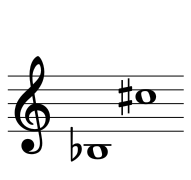
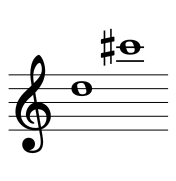
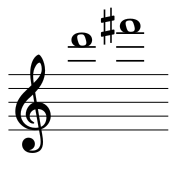
Pitches use scientific pitch notation (C4 is middle C). The step from the low register to the middle one is made with the octave key, played by the left thumb: the same fingering plus the octave key jumps up an octave, much as the flute overblows. The notes from D6 up are played with the palm keys (and the F♯6 with the high-F♯ key found on most modern saxophones); beyond that you are in the altissimo. Counting accidentals, the written range B♭3–F♯6 holds 33 pitches. One note on range: the modern baritone adds a key that reaches a written A3 (a half step lower), which the other three do not have.
How does the saxophone work?
Although it is made of brass, the saxophone is a woodwind: it sounds with a single reed on a mouthpiece, exactly like the clarinet. The acoustic difference is that its tube is conical (it widens), not cylindrical: that is why it overblows at the octave (with the octave key) instead of at the twelfth as the clarinet does, and why its fingering is so regular and easy to learn. It was invented by Adolphe Sax in the early 1840s, as an instrument that would join the power of brass with the agility of woodwinds.
Saxophone fingerings
The diagram is a real photo of an alto saxophone seen from the front: mouthpiece at the top and bell at the lower right. One detail is confusing at first: because you are looking at it from the front, your left hand appears on the right of the image. That is where the first three pearls (finger buttons), the palm keys and the left little-finger cluster (G♯ and the low notes) are. The right hand is on the left of the image, with the side keys and the E♭ and C keys of the little finger. The six mother-of-pearl buttons are numbered 1 to 6, three per hand. The octave key cannot be seen from the front: the left thumb presses it from behind, which is why it is shown in the small diagram beside the photo. First choose the member of the family (it changes the photo and the real note that sounds, not the fingers) and then a note: you will see its fingering lit on the photo, the note on the staff and how it sounds. The alto and the tenor have their own photograph; the soprano and the baritone show the alto, because all four are fingered exactly the same way.
The top note of the standard range, F♯6, deserves a comment: it is played with the F6 fingering plus the high-F♯ key, but there are other fingerings for it, used in fast passages and as a gateway to the altissimo register, so players learn more than one. To tune, use the saxophone tuner.
Common mistakes when learning saxophone notes
- Confusing the written note with the sounding one. If you play a written C on the alto and want a unison with a piano, the piano plays E♭. Each member transposes differently: check the table before playing with other instruments.
- Forgetting the octave key in the middle register. From D5 to C♯6 the fingering is the same as an octave lower plus the octave key; without it the note comes out low or "breaks".
- Biting to go higher. The upper register and the intonation are controlled with air and the throat, not by biting the reed: biting raises the pitch and chokes the sound.
- Neglecting the "bis" B♭ key. There are several ways to finger B♭; the bis key (with the left index finger) is the most comfortable in many passages and is worth automating early.
Summary
- The four saxophones (soprano, alto, tenor, baritone) share the same fingering and the same writing in treble clef; only the transposition changes.
- In B♭ are the soprano (a 2nd down) and the tenor (a 9th down); in E♭ are the alto (a 6th down) and the baritone (a 6th plus an octave down).
- Written range B♭3–F♯6 (33 pitches), with the octave jump made by the octave key; the baritone goes down to the written A3.
- It is a single-reed woodwind with a conical tube: it overblows at the octave, which makes its fingering very regular.