
Ornaments (or embellishments) are short notes that decorate a melody without changing its main line. They are written with small symbols or smaller notes, and each one "translates" into a specific realization, a group of quick notes, when played. In each example on this page you will see how the ornament is written and how it is played, and you can press ▶ to hear its realization.
Ornaments are usually grouped in two kinds: those of a single note (the appoggiatura and the acciaccatura) and those of several notes (the mordent, the turn and the trill).
We take G as the main note, with its upper neighbor (A) and its lower neighbor (F).
The appoggiatura
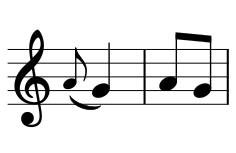
The appoggiatura (Italian for "leaning note") is an ornamental note that "leans" on the main note and takes part of its duration. The long appoggiatura takes half the value of the main note (or two thirds if the main note is dotted). It is written as a small note without a slash, slurred to the main note.
The acciaccatura (short appoggiatura)
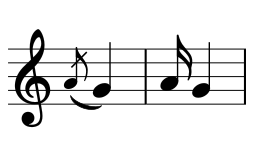
The acciaccatura or short appoggiatura is a small note with a slash through its flag, played as fast as possible, taking almost no time from the main note: it sounds like a quick tap just before the beat.
The mordent
The mordent is a very quick alternation of the main note with one of its neighbors, played as the beat arrives. Depending on which neighbor it uses, there are two: the upper mordent and the lower mordent.
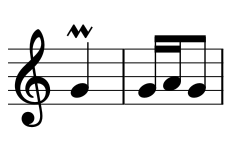
The upper mordent alternates with the note immediately above (main → upper → main). Its sign is a short wavy line.
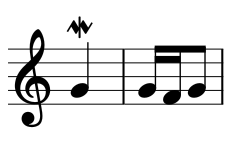
The lower mordent alternates with the note immediately below (main → lower → main). It is written with the same wavy line crossed by a short vertical stroke.
The turn
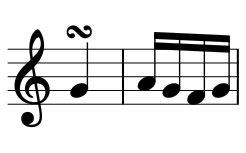
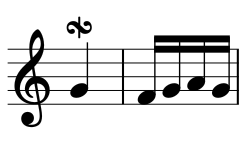
The turn (Italian grupetto) is a group of four notes that circle around the main note. Depending on which auxiliary note it starts on, there are two: the turn and the inverted turn.
The turn starts on the upper note: upper, main, lower and the main note again. Its sign is a small sideways S ().
The inverted turn starts on the lower note: lower, main, upper and the main note again. Its sign is the same sideways S with a short vertical stroke.
The trill
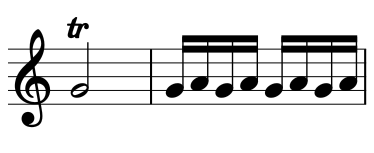
The trill is the fast, sustained alternation of the main note with its upper neighbor, kept up for the whole value of the written note. It is shown with the letters tr (often followed by a wavy line showing how long it lasts). It is the showiest and longest of the ornaments.
One important detail: the starting note depends on the period. In Baroque and Classical music a trill normally begins on the upper note, like a small appoggiatura before the main note. In later music, and in many modern editions, it often begins on the main note, as in the example below. When in doubt, follow the style of the piece.
Summary of ornaments
| Ornament | Symbol | Notes | How it is played (on G) |
|---|---|---|---|
| Appoggiatura | Small note (no slash) | 1 (+ the main note) | The ornamental note takes half the value: A–G. |
| Acciaccatura | Small slashed note | 1 (+ the main note) | The ornamental note, very short, before the beat: A–G. |
| Upper mordent | Wavy line | 3 | Main–upper–main: G–A–G. |
| Lower mordent | Wavy line with a vertical stroke | 3 | Main–lower–main: G–F–G. |
| Turn | Sideways S | 4 | Upper–main–lower–main: A–G–F–G. |
| Inverted turn | Sideways S with a vertical stroke | 4 | Lower–main–upper–main: F–G–A–G. |
| Trill | tr (with a wavy line) | varies | Fast, sustained alternation with the upper note: G–A–G–A… |
Ornaments rely on the second intervals to neighboring notes, and they enrich the musical phrase together with articulation. Be clear about the accidentals of the auxiliary notes, and practice ornaments with a steady beat on the online metronome.