
Articulation is the way each note is attacked, joined or separated. While dynamics show how loud and tempo shows how fast, articulation shows how each note is played: whether notes are linked smoothly or released short, whether they stand out or are sustained. It is one of the performer's main expressive tools.
The main articulations
| Articulation | Symbol | Effect |
|---|---|---|
| Legato (connected) | slur (curved line) | Notes joined, with no gap |
| Staccato (detached) | small dot above or below the note | Short, separated notes |
| Accent | > (angle) | Note attacked with more force |
| Tenuto | horizontal line (—) | Hold the note for its full value, with weight |
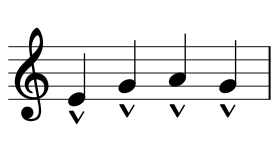
| Marcato | ^ (strong accent) | Very marked and energetic |
Above or below the note? Articulation signs (dots, accents, etc.) go on the side opposite the stem: if the stem points up, the sign sits below the notehead. If the stem points down, it sits above. In the examples below the notes have stems pointing up, so the articulations appear under the noteheads.
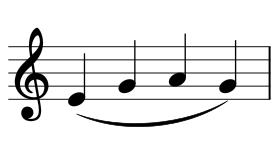
Legato (connected)
The notes are played joined and without interruption, moving smoothly from one to the next. It is shown with a slur, a curved line over the group of notes. It is the opposite of staccato.
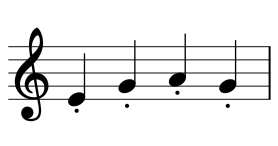
Staccato (detached)
The notes are played short and separated, released before their full value (roughly halfway). It gives a light, bouncy character. It is shown with a dot above or below the notehead.
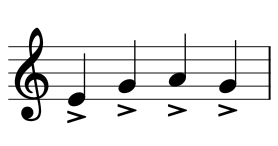
Accent
The note is attacked with more force than the notes around it, standing out without changing the overall dynamic level. It is written with an angle-shaped sign (>) above or below the note.
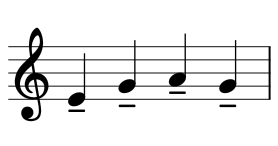
Tenuto
It means hold the note for its full value, giving it some weight or emphasis, without shortening it or accenting it sharply. It is written with a small horizontal line above or below the note.
Marcato
An accent that is stronger and more energetic than the normal one: the note is attacked in a very marked way. It is written with a vertical wedge-shaped sign (^) next to the note.
There are also combinations, such as staccatissimo (even shorter, with a wedge instead of a dot) and portato or mezzo-staccato (dots under a slur: notes slightly separated but smooth; not to be confused with portamento, which slides the pitch between two notes). Articulation is always combined with dynamics and tempo to bring life and expression to a performance.
Practice: test whether you recognize the main articulation marks with our interactive quiz, in both directions (name to symbol and symbol to name).