
Portamento is an expressive slide from one note to another: the voice or the instrument "carries" the pitch from the first note to the second instead of jumping from one to the other. It is typical of singing and string playing, and it is often not written in the score: the performer decides. It is one of the performance effects, and it is very close to the glissando.
The word comes from the Italian portare, "to carry": in singing, portamento di voce meant "carrying the voice" from one note to the next.
How it sounds and how it looks
The same interval, from C to E, played in three different ways. The graph shows the pitch of the note over time:
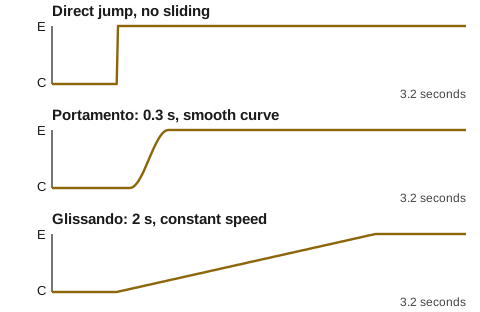
Notice the difference. In the portamento the change of pitch is short and smooth; it feels like a "drag" toward the arrival note, and the curve starts slowly, speeds up and slows down on arrival. In the glissando the slide is long and at constant speed, and it is heard as an effect in itself.
Portamento and glissando
The two names are sometimes used as synonyms, and the border between them is not absolute: it depends on the instrument and the tradition. As a rough guide:
| Aspect | Portamento | Glissando |
|---|---|---|
| What it is | An expressive link between two notes, in which the pitch slides toward the target note. | A run between two pitches, often a wide one, heard as an effect. |
| Usual length | Normally short. | Usually takes more time of its own. |
| In the score | Usually decided by the performer. | Usually marked with a line and gliss. |
| Typical instruments | Voice and bowed strings. | Voice, strings, slide trombone; stepped on piano and harp. |
Where it is used
- Singing: it has been an expressive device for centuries, and taste has changed a lot with period and style: what is natural in some repertoires is avoided in others. In popular music, sliding between notes is very common.
- Bowed strings: when shifting position, the finger can slide along the string and let the slide be heard. On the violin and the cello, its use has varied across periods.
- Slide trombone: the slide lets the pitch move continuously between notes. See the trombone.
- Synthesizers: many have a function called exactly portamento (or glide), which slides the pitch between notes played one after another.
Not to be confused with portato
Portato has nothing to do with sliding pitch: it is an articulation halfway between legato and staccato, in which the notes are played slightly separated. The names look alike, but one affects pitch and the other affects how notes are attacked and joined. It is also not the same as legato, which joins notes without a gap but without sliding the pitch between them.
How it is written
Portamento has no universal sign. Some scores use a short line between the two notes or markings such as port., while in many styles it is left to the performer's judgment. For the glissando sign, with its line and the abbreviation gliss., see the glissando page.
To train control of your voice between two notes, try the javelin throw game, where you have to slide from one note to another at a steady speed.