
Performance effects are techniques that change how sounds are produced, connected or repeated: sliding from one note to another, playing a chord note by note, making the pitch of a long note waver, or repeating a note very fast. Some are marked with signs or words in the score, such as glissando, arpeggiato and tremolo; others depend more on the conventions of the instrument, the style or the performer’s choices, such as portamento and vibrato. “Performance effects” is a teaching category: the boundaries between them, and with ornaments, are not absolute.
The most common effects
| Effect | What it is | How it is marked | Instruments |
|---|---|---|---|
| Glissando | A slide from one note to another: continuous or as a rapid run of notes, depending on the instrument. | A straight or wavy line between the two notes, often with gliss. | Voice, violin and slide trombone; on piano and harp, through successive notes. |
| Portamento | An expressive link between two notes, sliding the pitch toward the destination note. | Usually left to the performer; sometimes shown with a short line or port. | Voice and bowed strings, among others. |
| Arpeggiato (rolled chord) | The notes of a chord are played one after another instead of together. | A vertical wavy line before the chord; an arrow shows the direction. | Piano, harp, guitar and strings. |
| Vibrato | A periodic oscillation of pitch around a sustained note, which adds expressiveness to the sound. | Usually not written; sometimes shown with vib. or other conventions. | Voice, bowed strings and winds. |
| Tremolo | Very fast repetition of one note, or fast alternation between two. | Slashes on the stem (or between the two notes, if alternating). | Bowed strings, piano and percussion. |
Glissando
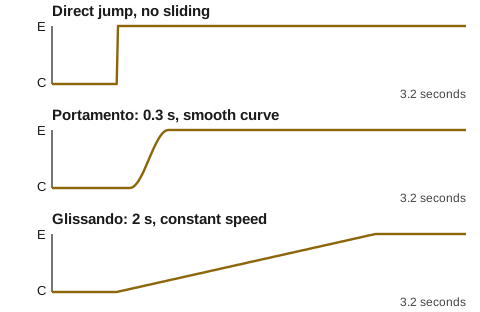
The glissando connects two notes with a slide of pitch. The result depends on the instrument: on the voice, the violin or the slide trombone the pitch can change continuously; on the piano the effect is made by quickly running over a series of keys. Its own page shows how it is written, examples you can listen to, and the difference from portamento.
Portamento
The portamento is a short, expressive drag between two notes, typical of singing and of bowed strings, and often left to the performer. It is similar to glissando but shorter and smoother. Its own page lets you hear the difference between a direct leap, a portamento and a glissando.
Arpeggiato
The arpeggiato (a rolled or spread chord) spreads out the notes of a chord: they enter one after another, normally from lowest to highest (although it can also go downward), and keep sounding. It is written with a wavy line before the chord. It is not the same as an arpeggio, in which each note is played with its own duration.
Vibrato
The vibrato is a periodic oscillation of pitch around a note, normally about five to seven times per second, which adds expressiveness to a long note: although the pitch fluctuates slightly, the note is still heard as the same. It is typical of the voice and of bowed strings.
Tremolo
The tremolo repeats the same note, or alternates two, at high speed, and is written with slashes across the stem. Do not confuse it with vibrato: vibrato moves the pitch; tremolo re-attacks the note again and again.
Performance effects and ornaments
The ornaments (appoggiatura, acciaccatura, mordent, turn and trill) embellish the melody with ornamental notes or formulas. Performance effects focus on how the sound is produced: sliding between pitches, spreading a chord, wavering a note or repeating sounds very fast. The distinction is not absolute: some techniques can be classified differently depending on the instrument, the tradition or the context (the glissando, for example, is sometimes listed among ornaments). To study the signs and function of ornaments, see also the page on musical ornaments.
To practice
You can practice pitch slides with your voice in the javelin throw game, in which you slide your voice from one note to another at constant speed. To understand the distance between the starting and ending notes, also review musical intervals.