
An arpeggiated chord (also called a rolled chord, or a chord that is arpeggiated or spread) is a chord whose notes are not played at the same time but one after another, usually from the lowest note to the highest. It is shown by a vertical wavy line in front of the chord. It is one of the performance effects: it does not change the notes of the chord, only the way they are played.
How it is written
The chord is written with all its notes lined up vertically, and a wavy line is added in front of it, covering the lowest to the highest note. The line means that the notes are played in succession. Normally the roll goes upward, from the lowest note to the highest. An arrow pointing down at the end of the line means the roll goes downward.
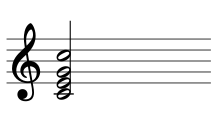
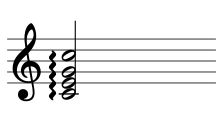
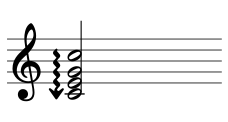
In piano music, the wavy line can span both staves (UK: staves) when the chord is shared between the two hands and a single roll is wanted.
Listen to it
Listen to the same C major chord (C, E, G, C) in four ways. In the block chord, all the notes start together. In the arpeggiated chord, they enter one after another, as the wavy line asks; in this example, the notes keep sounding while the others enter. In the arpeggio, the notes form a melodic line with their own rhythm and, here, each one is released before the next begins.
Arpeggiated chord vs. arpeggio
They are similar, but they are not the same thing:
| Aspect | Arpeggiated chord | Arpeggio |
|---|---|---|
| What it is | A chord whose notes are played in succession instead of together. | A series of notes that runs through the notes of a chord, usually as a melodic figure. |
| How it is written | The notes are stacked vertically like a chord, with a wavy line in front. | The notes are written one after another, each with its own pitch and rhythmic value. |
| Length of the notes | They can overlap and keep sounding while the others enter, depending on the instrument and the performance. | Set by the note value of each note; the notes may overlap or be separated. |
| Rhythm | The wavy line says the notes are played in succession; the exact timing is left to the performer. | The rhythm is written with note values and the other signs in the score. |
To review how the chord is built, see the major triad and triads. To sing an arpeggio, the triple jump game asks you for the three notes of a chord one after another.
What it is used for, and on which instruments
- Piano: it spreads the notes of a chord over time, giving a sense of breadth and motion, and it can make very wide chords easier to play. See the piano.
- Harp: the notes of the chord are plucked in succession, one string after another, which is very natural on this instrument.
- Guitar: the notes can be plucked one by one with the fingers or a pick instead of strumming the chord. See the guitar.
- Bowed strings: chords of three or four notes are usually played in succession or split over several bow strokes, because the bow cannot normally keep all those strings sounding with the same strength at once. Two-note intervals (double stops), however, can be played together. See bowed strings and, as an example, the violin.
Related performance effects
The arpeggiated chord makes the notes of a chord enter one after another. The glissando connects two pitches with a slide or a fast run of notes. The tremolo repeats one note quickly or alternates quickly between notes.
Piano audio: Salamander Grand Piano samples by Alexander Holm, licensed under CC BY 3.0.