
Tremolo means repeating the same note very fast, or alternating very fast between two notes, for the whole written value. It is shown by slanted slashes across the stem of the note. It is one of the performance effects, and it gives a long note movement, tension or shimmer.
How it is written
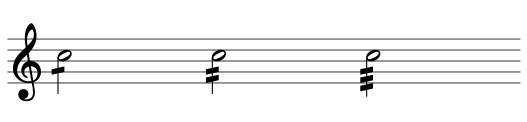
The slanted slashes show the rhythmic subdivision of the tremolo. In the examples below, one slash means eighth notes, two mean sixteenth notes and three mean thirty-second notes. So a half note (UK: minim) with three slashes is played as repeated thirty-second notes for the length of the half note. In other contexts, especially on bowed strings, unmeasured tremolo is used: the player repeats the note as fast as possible, and each repetition does not need to be heard or counted as an exact subdivision. How it is played depends on the type of tremolo and on the musical context.
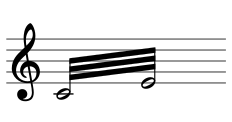
Alternating tremolo is written with two notes joined by diagonal beams: the two notes alternate quickly at the subdivision shown. In this example, the two half notes with three beams mean an alternation of C and E in thirty-second notes for the combined length of a whole note.
Listen to it
First, one long note without tremolo, for comparison. Then the same note struck many times in a row, and finally the alternating piano tremolo between C and E:
The repeated note uses a synthetic sound, not the tone of a violin: it demonstrates the mechanism and is not a recreation of a bow tremolo. It helps you recognize a fast repetition of the same pitch; a bow tremolo has a different sound and articulation.
Where it is used
- Bowed strings: the bow moves very fast, back and forth, on the same string: this is the "bow tremolo". See the violin and the cello.
- Piano: tremolo is usually a fast alternation between two notes or two chords. See the piano.
- Mandolin and guitar: the mandolin, whose pick cannot sustain a sound, uses tremolo to prolong a note. On classical guitar there is a famous tremolo piece: Recuerdos de la Alhambra by Francisco Tárrega, where the fingers repeat the melody note while the thumb plays the bass accompaniment. See the guitar.
- Percussion: the usual term is the roll, a very fast repetition of strokes that is played in different ways depending on the instrument. See the timpani.
Tremolo vs. vibrato
Vibrato is a gentle oscillation of the pitch of a single note; tremolo, on the other hand, repeats the note (or alternates two) and does not change the pitch of each note. The names of some devices add to the confusion. On the vibraphone, the motor switch labeled "vibrato" makes the volume oscillate, not the pitch, so strictly speaking it is a tremolo. On the electric guitar, the "tremolo" of some amplifiers varies the volume. The so-called tremolo arm (whammy bar), however, changes the tension of the strings and so changes their pitch; when it is used to oscillate periodically between pitches, it produces a vibrato effect.
It is not a trill either: a trill alternates a note with the note just above it, while an alternating tremolo joins any two notes, often farther apart.
Related performance effects
For other effects with notes following one another, see the arpeggiated chord, which spreads the notes of a chord over time, and the glissando, which slides the pitch between two notes.
Piano audio: Salamander Grand Piano samples by Alexander Holm, licensed under CC BY 3.0.