
Vibrato is a small, regular oscillation of the pitch of a sustained note: the tuning rises and falls slightly several times per second around a central pitch. It adds expression and is characteristic of the voice and of many string and wind instruments. Its speed and width depend on the instrument, the performer and the musical style. It is one of the performance effects: even though the pitch varies slightly, we still hear one single note.
What a vibrato is like
A vibrato is described by two numbers: its speed (how many times per second the pitch oscillates) and its width (how far it rises and falls, measured in cents; a half step (UK: semitone) is 100 cents). The values are approximate and depend on the instrument, the performer and the style. Here are four cases on the same note:
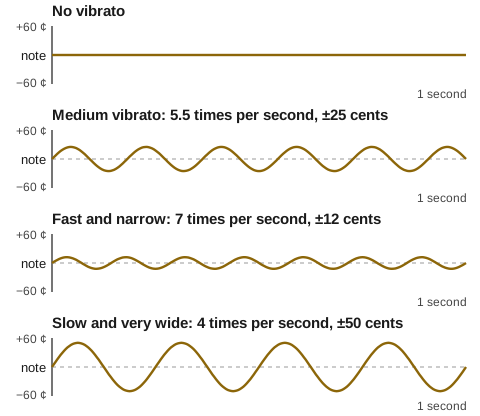
Listen to the four examples on the same A and compare how the effect changes as the speed and width of the oscillation change. The last example uses an especially wide vibrato so that the difference is easy to hear:
These are synthetic tones, without the timbre of any instrument: they let you hear how speed and width change the effect, not how a violinist or a singer sounds.
How it is produced on each instrument
- Voice: vocal vibrato comes from the coordination of the voice-production system and breathing. In classical singing it is commonly used as an expressive device, though how much is used and what it is like depend on vocal technique and style.
- Bowed strings: the finger that presses the string rocks on it, and this moves the pitch. See the violin, the viola and the cello.
- Winds: vibrato is made with small controlled variations of the sound, and the technique depends on the instrument. On the flute it mainly involves control of the air and the embouchure; on the oboe and the clarinet, control of the air column and the embouchure; and on brass, coordination of the air with the lips. On the trombone, a pitch slide with the slide is also possible. On the clarinet, the use of vibrato varies with style and repertoire.
- Guitar: it is made by moving the finger on the fretted string. See the guitar.
- Piano: it cannot do it, because the pitch of each note is fixed in advance. The same is true of the xylophone and the marimba.
On the vibraphone, a motor turns discs that open and close the resonators, and this produces a periodic variation of volume, not of pitch. The name used varies with context ("vibrato" or tremolo), but it should be kept apart from the pitch vibrato explained here: in pitch vibrato, what oscillates is the tuning of the note.
How it is written
Vibrato is almost never written: it is taken for granted in the voice and in strings, and each performer adapts it to the style and period. When a composer wants to indicate it, they use the abbreviation vib. or a wavy line over the note. To ask for the opposite there are markings such as senza vibrato or non vibrato ("without vibrato"), and to ask for more, molto vibrato.
Vibrato, tremolo and trill
These are three effects that are easy to confuse, because in all of them "something moves":
| Effect | What moves | What it is like |
|---|---|---|
| Vibrato | The pitch of a note. | A small, regular oscillation around a central pitch, while you still hear a single note. |
| Tremolo | The repetition of a note, the alternation between two notes, or the loudness of the sound, depending on context. | Fast repetitions, alternating notes, or a periodic variation of loudness. |
| Trill | Two neighboring notes. | A fast alternation between the written note and a nearby note, normally the one above. It is an ornament. |
Vibrato and tuning
When a note has vibrato, its pitch oscillates around a central pitch. This is why, in front of a tuner, the display may move from side to side. To judge the tuning, look at the pitch around which it oscillates instead of trying to keep the needle still.
To train your voice's tuning without vibrato, try the pitch-singing games.