
Pitched percussion is the percussion that gives notes. Unlike the snare drum, the bass drum or the cymbals, which produce a strike with no recognizable pitch, these instruments play melodies and harmonies: they have their own notes, their range and their place in the score like any other instrument.
This page brings together the seven that are usually found in an orchestra or a band: what sets them apart, how much each one covers and, the part that causes the most trouble, which ones sound where they are written and which do not. Not all of them are always present: some are standard, others appear only when a work calls for them.
The seven pitched percussion instruments are the timpani, the xylophone, the marimba, the vibraphone, the glockenspiel, the tubular bells and the crotales:
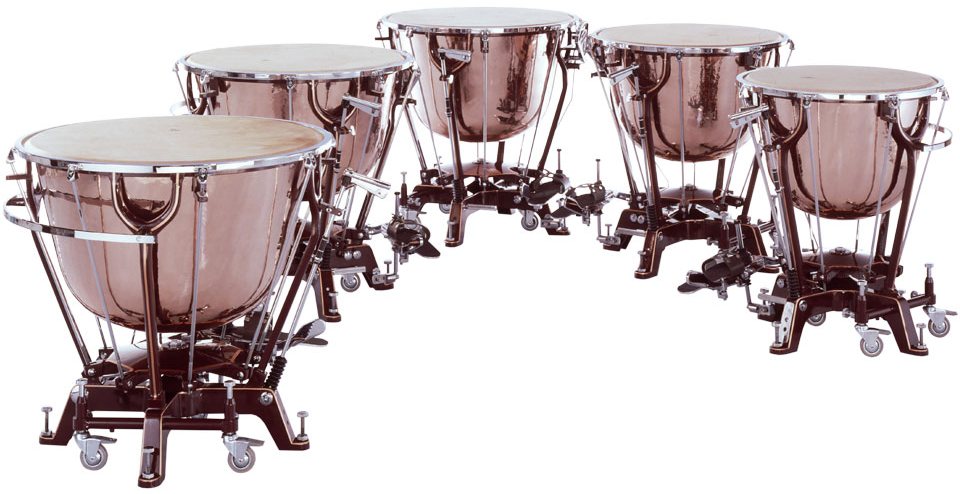
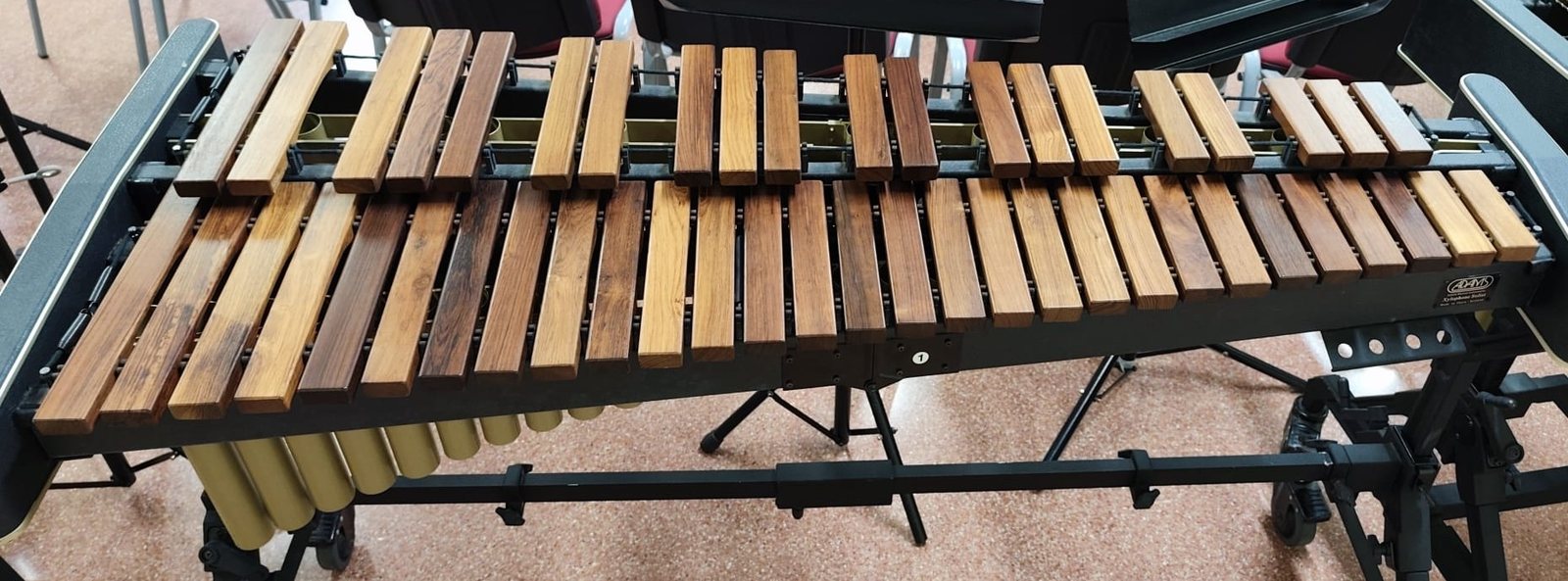
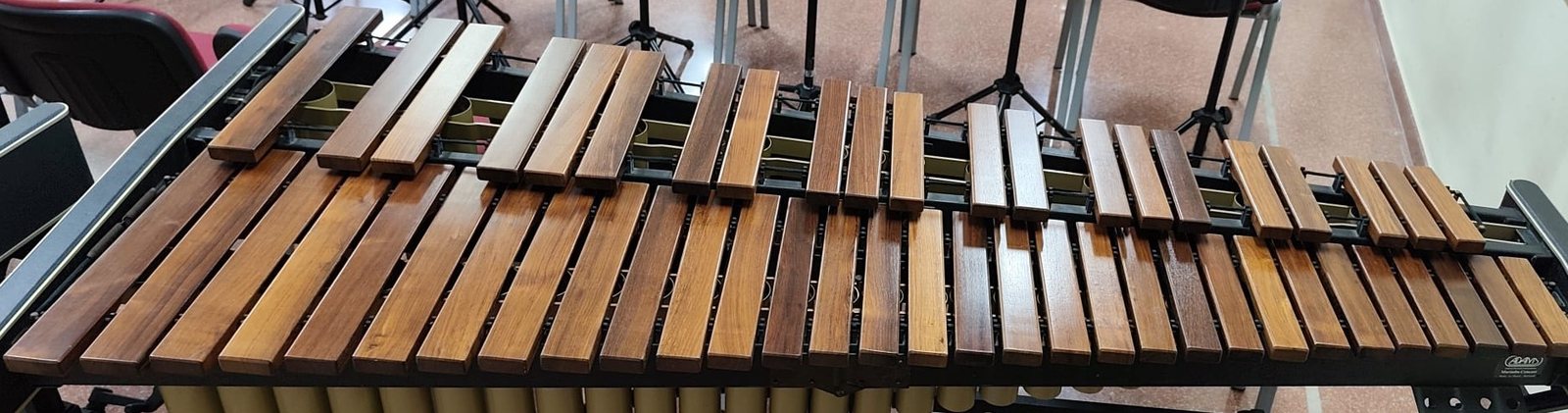
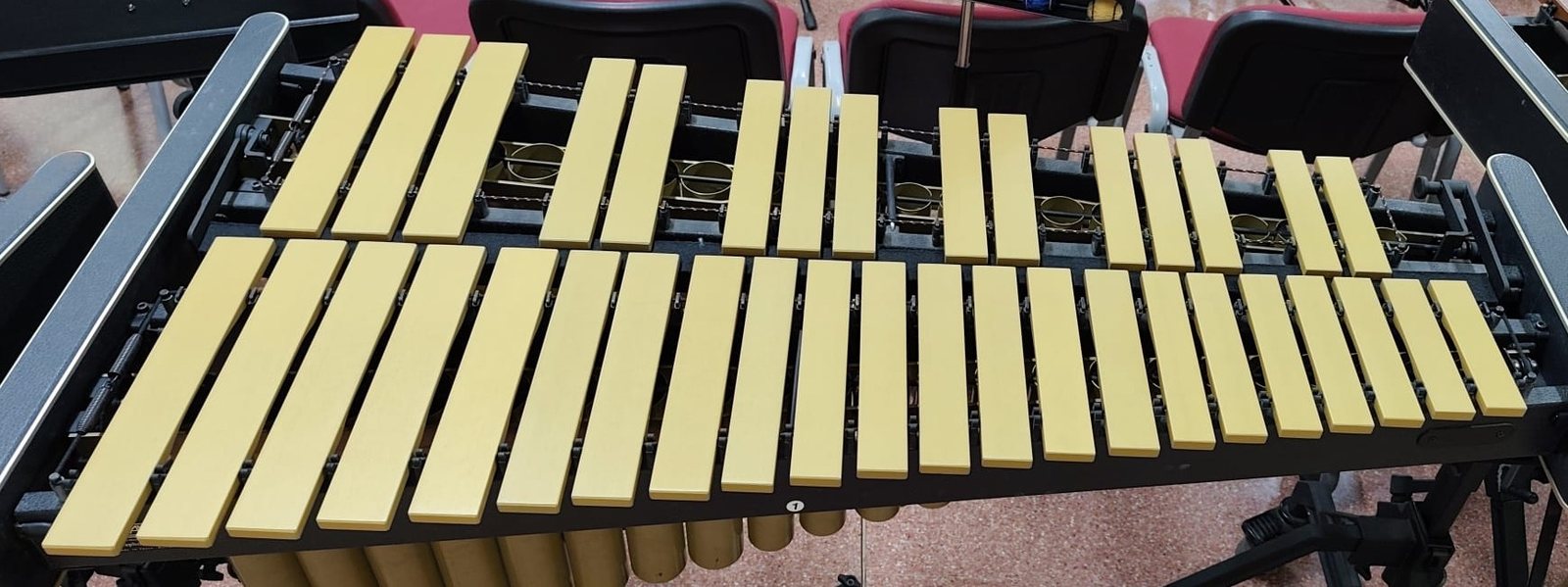
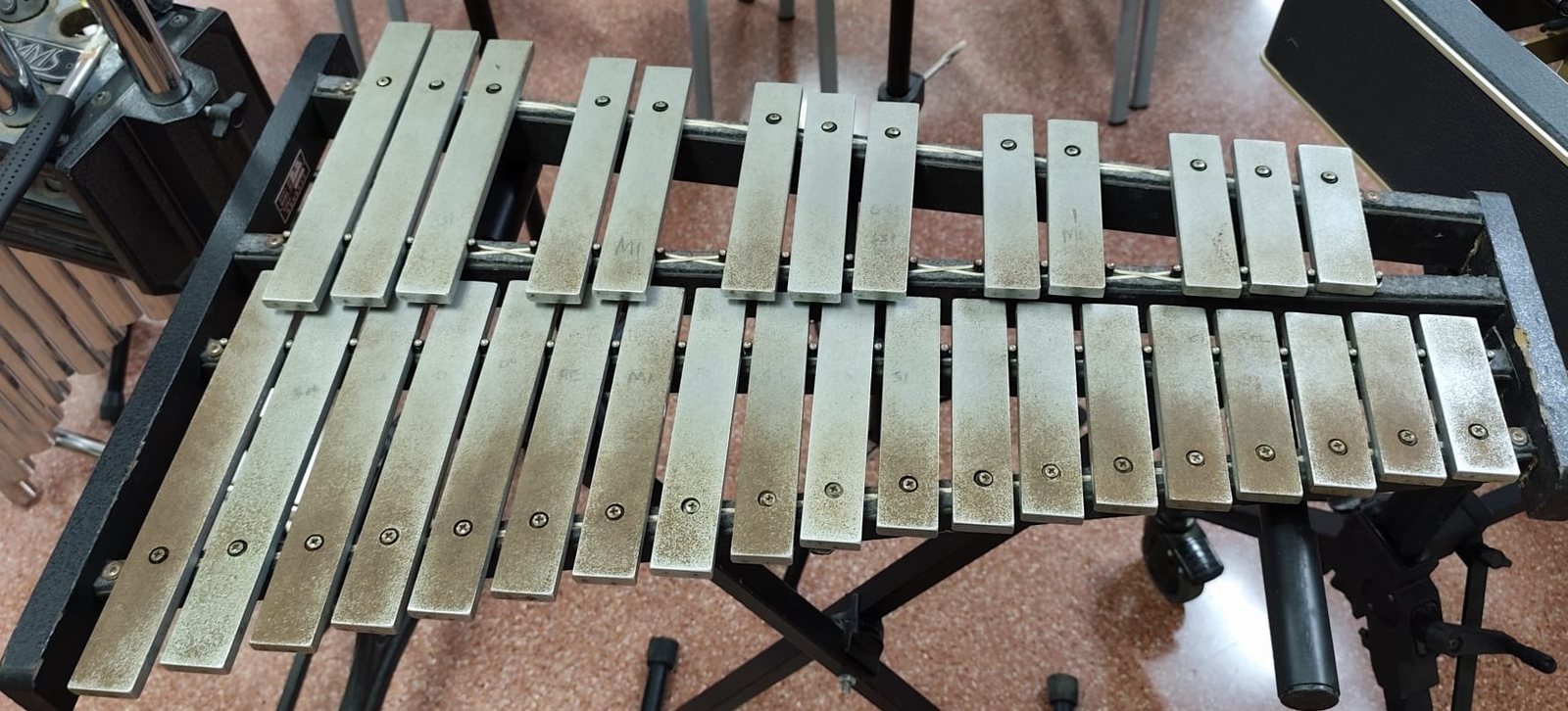
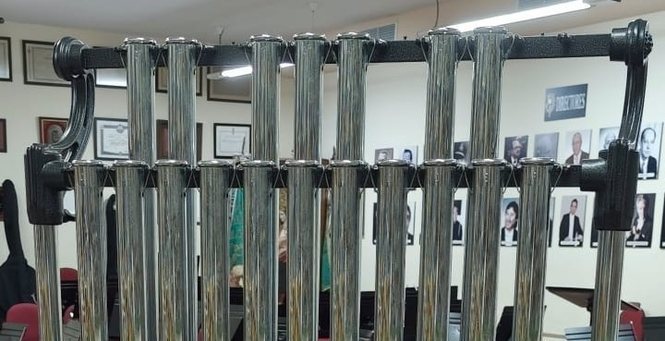



Photos by Eduardo Escrig, except where indicated. Timpani: Lefima GmbH, CC BY-SA 3.0; Crotales: Xylosmygame, CC BY-SA 3.0.


What “pitched” means
An instrument has definite pitch when its sound lets you hear a specific note. That depends on how it vibrates: if the modes of vibration are in simple proportions, the ear recognizes a pitch; if they are scattered at random, we hear noise with a color but no note.
A cymbal spreads its energy over so many, and such closely packed, partials that there is no note to pick out; this is the case for all unpitched percussion. A marimba bar, on the other hand, is carved thinner underneath precisely so that its first partials fall in harmonic proportions, and that is why it sings.
Two cases deserve a paragraph of their own, because the note we hear is not in the sound: in the timpani and in the tubular bells, the frequency of the note itself has hardly any energy. What is there are partials in proportions close to 2, 3 and 4, and the ear reconstructs the missing fundamental. It is the harmonic series read backwards: instead of starting from a fundamental to work out its partials, the ear starts from the partials to work out the fundamental.
The seven instruments
They are grouped by how they produce sound, which is also what explains their tone:
- A stretched drumhead. The timpani, the only one in the family where each drum gives one note at a time and the pitch has to be changed with the pedal.
- Wooden bars with resonators. The xylophone, dry and cutting, and the marimba, warm and full-bodied.
- Metal bars. The vibraphone, made of aluminum with a pedal and a motor, and the glockenspiel, made of steel and very high.
- Bronze discs. The crotales, which are not bars but solid, thick discs with a very long ring.
- Tubes. The tubular bells, which imitate the peal of a church tower.
Four of them have bars (xylophone, marimba, vibraphone and glockenspiel) and the crotales are discs and the tubular bells are tubes, but all of them except the timpani share something that makes life much easier: they are laid out like the piano keyboard, with the naturals in front and the sharps and flats behind in groups of two and three. Anyone who reads piano music knows how to find their way around any of them.
Comparison chart: range and transposition
This is the chart to keep at hand when writing for percussion. The “sounds” column is what comes out of the instrument; the “written” column is what goes on the paper.
| Instrument | Written | Sounds | Transposes |
|---|---|---|---|
| Timpani (set of 5) | D2–C4 | D2–C4 | no |
| Marimba (5 octaves) | C2–C7 | C2–C7 | no |
| Vibraphone | F3–F6 | F3–F6 | no |
| Tubular bells | C4–F5 | C4–F5 | no |
| Xylophone (3.5 octaves) | F3–C7 | F4–C8 | one octave |
| Glockenspiel | G3–C6 | G5–C8 | two octaves |
| Crotales (2 octaves) | C4–C6 | C6–C8 | two octaves |
The ranges are approximate, those of the most common sizes, and vary by model: the marimba is made in sizes from four to five octaves, the xylophone from three to four, and crotales are sold in single octaves. Octave numbers follow scientific pitch notation, in which middle C is C4. Some catalogs, especially in French- and Spanish-speaking countries, use a system in which that same C is called C3, so every number in the chart would go down by one.
The three that transpose, and why
The xylophone, glockenspiel and crotales sound higher than written: the xylophone by an octave, the glockenspiel and the crotales by two. This is not a whim or a historical leftover as with the clarinet or the horn: their real register is so high that writing them where they sound would fill the part with unreadable ledger lines.
For the player nothing changes (they read and strike the bar they see), but for the composer or conductor it changes everything: a unison on paper between the xylophone and the flute will sound in octaves, and a glockenspiel part written “where it sounds” would ask for notes the instrument does not have.
There is an added trap when looking at catalogs and rental lists: two ways of numbering octaves are in use, the scientific system (middle C is C4) and the French-Belgian one (that same C is C3). That is why the same set of crotales can be advertised as C4–C5 in one shop and as C3–C4 in another. This page uses the scientific system; if the numbers do not add up, check which system the source uses first.
What gets damped and what does not
Metal keeps sounding long after the strike, and managing that is half the technique of this family. Each instrument handles it in its own way:
| Instrument | How it is damped |
|---|---|
| Vibraphone | Pedal, and it is part of the phrasing |
| Tubular bells | Damper pedal |
| Glockenspiel | By hand; models with a pedal, with the pedal |
| Crotales | Only by hand |
| Timpani | With the hand on the head |
| Xylophone and marimba | Not needed: wood dies away by itself |
A practical rule for writing follows: on the wooden instruments, to sustain a note you need a roll (tremolo); on the metal ones, what you have to plan is the opposite, how to cut it off.
In the band and in the orchestra
Not all of them are always present. Timpani, xylophone, glockenspiel and tubular bells form the stable core of pitched percussion in the band, and the glockenspiel also has its marching version (the lyre), a frame that is carried on the body and played with a single mallet.
The marimba and the vibraphone appear in modern repertoire and in contest pieces, and they are the two with the most solo repertoire, where they are played with four mallets. The crotales are the extreme case: they are not part of the lineup of almost any ensemble and are rented when a work calls for them.
In the orchestra, the timpani are part of the standard section; the rest (xylophone, lyre, tubular bells, marimba, vibraphone and crotales) appear only when the work calls for them.
A little history
The timpani are the veterans: they enter the orchestra in the 17th century and for a long time were the only regular pitched percussion. The rest is recent. Tubular bells were invented in the 19th century to replace the bells of a church tower, which cannot be moved or tuned. The xylophone earned its place in the late 19th century, associated with the sound of bones. And the vibraphone is the youngest: it was born in the United States in the 1920s, and jazz made it a solo instrument before orchestral music did.
In summary
- Seven instruments: timpani, xylophone, marimba, vibraphone, glockenspiel, tubular bells and crotales.
- The four with bars and the crotales are laid out like a piano keyboard.
- Three transpose: the xylophone by one octave, the glockenspiel and the crotales by two, always upward.
- On the metal ones you have to plan how to damp; on the wooden ones, how to sustain.
- On timpani and bells, the note you hear is a fundamental that the ear reconstructs.