
To invert an interval, keep the first note fixed and move the second note one octave in the opposite direction to the interval: if the interval is ascending, the second note drops an octave; if it is descending, the second note rises an octave. The key rule is that the number of the original interval and the number of its inversion always add up to 9 (for simple intervals), and the quality is swapped: major ↔ minor, augmented ↔ diminished, perfect ↔ perfect.
Chart of inversions of simple intervals
| Original interval | Quality | Inversion | Resulting quality | Example (from the first note) |
|---|---|---|---|---|
| Unison (1st) | Perfect | Octave (8th) | Perfect | C–C → C–C (octave) |
| 2nd | Major | 7th | minor | C–D → C–D (octave lower) |
| 2nd | minor | 7th | Major | E–F → E–F (octave lower) |
| 3rd | Major | 6th | minor | C–E → C–E (octave lower) |
| 3rd | minor | 6th | Major | D–F → D–F (octave lower) |
| 4th | Perfect | 5th | Perfect | C–F → C–F (octave lower) |
| 4th | Augmented | 5th | Diminished | F–B → F–B (octave lower) |
| 5th | Perfect | 4th | Perfect | C–G → C–G (octave lower) |
| 5th | Diminished | 4th | Augmented | B–F → B–F (octave lower) |
| 6th | Major | 3rd | minor | C–A → C–A (octave lower) |
| 6th | minor | 3rd | Major | E–C → E–C (octave lower) |
| 7th | Major | 2nd | minor | C–B → C–B (octave lower) |
| 7th | minor | 2nd | Major | G–F → G–F (octave lower) |
| Octave (8th) | Perfect | Unison (1st) | Perfect | C–C (octave) → C–C (unison) |
In the examples, the first note stays fixed and the second note drops an octave ("octave lower"); if the interval were descending, the second note would rise an octave. For instance, the major 2nd C4–D4 inverts to C4 with D3 below it: a minor 7th (from D3 up to C4 is 10 half steps).
What is inversion used for in practice?
Knowing inversions is not an abstract exercise: it has direct uses in harmony and analysis.
- Chord inversions. When the fifth of a chord goes to the bass, the 5th between root and fifth becomes a 4th above the bass. This is why a triad in second inversion is labeled 6/4.
- Ear training. It is easier to recognize a minor 7th as "the inversion of a major 2nd" than to identify it directly.
- Reducing compound intervals. A major 9th is a major 2nd plus an octave, so its reduction gives the same interval as the major 2nd. See the guide to augmenting and reducing intervals.
How to invert simple intervals
To invert a simple interval, the first note stays fixed and the second note moves one octave in the opposite direction to the interval: if the interval is ascending, the second note drops an octave; if it is descending, the second note rises an octave. (The same result comes from moving the lower note up an octave.)
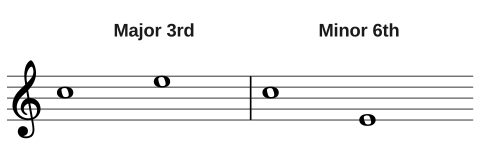
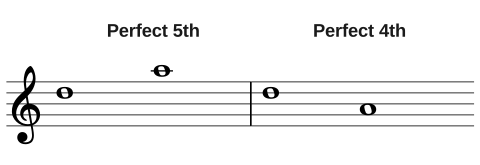
How to check that the inversion is correct
For simple intervals, the number of the original interval plus the number of its inversion is always 9. As for quality:
- Perfect → the inversion is perfect
- Major → the inversion is minor
- minor → the inversion is major
- Augmented → the inversion is diminished
- Diminished → the inversion is augmented
How to invert compound intervals
To invert a compound interval, the first note stays fixed and the second note moves three octaves (a 22nd) in the opposite direction: if the interval is ascending, the second note drops a 22nd; if it is descending, the second note rises a 22nd.
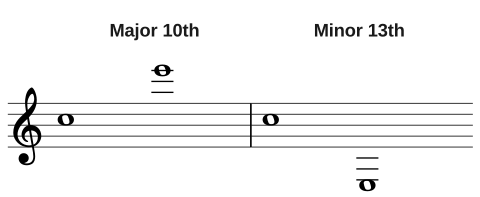
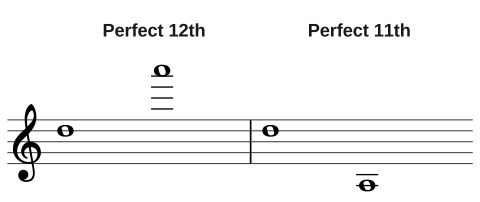
How to check that the inversion is correct
The number of a compound interval and the number of its inversion add up to 23. The quality rules are the same as for simple intervals: perfect ↔ perfect, major ↔ minor, augmented ↔ diminished.
For the full chart of intervals with their half steps and qualities, see musical intervals.