
In music theory, the beginning of a phrase can be of three types, depending on where its first note falls in relation to the first strong beat of the measure (UK: bar). Telling them apart helps you phrase well, prepare an entrance when conducting or singing, and analyze a piece correctly.
The names thetic, anacrusic and acephalous come from the Spanish-language analysis tradition. English-language books usually just say that a phrase starts on the downbeat, with a pickup (UK: upbeat; the technical word is anacrusis), or on an off-beat after a rest. Both sets of names are given here.
- Thetic (starts on the downbeat): the first note falls on the strong beat (beat 1 of the measure).
- Anacrusic (starts with a pickup): the phrase begins before the strong beat, with an anacrusis.
- Acephalous (starts after a rest on the downbeat): the strong beat is silent and the music enters just after it.
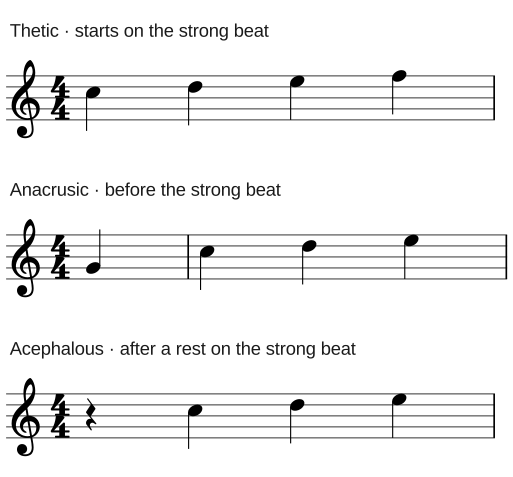
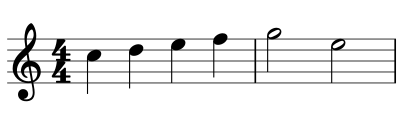
Thetic beginning (on the downbeat)
A thetic beginning starts on beat 1 of the measure, right on the strong beat. It is the most common type and sounds firm from the first note. The first measure is complete.
Anacrusic beginning (with a pickup)
An anacrusic beginning starts on a weak part of the measure, before the first strong beat, with one or more notes called an anacrusis (US: pickup). These notes create momentum toward the first strong beat. The first measure is incomplete, and it is completed by the last measure of the phrase: together they add up to one full measure.
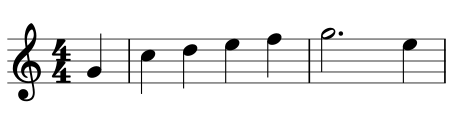
Very many melodies begin with a pickup. Well-known examples are Happy Birthday and Beethoven’s Für Elise.
Acephalous beginning (off-beat start after a rest)
“Acephalous” means headless: this beginning leaves the first strong beat (or part of it) silent and the music enters just after it, on a weak part. The initial rest may be written (the measure looks complete, starting with a rest) or not (the measure looks incomplete). What separates it from a pickup is when the music enters. In the Spanish tradition, in an acephalous beginning the music enters after the strong beat but before the middle of the measure; in an anacrusis it enters at the middle of the measure or later. Not every textbook draws the line in exactly this place, so use it as a working rule.
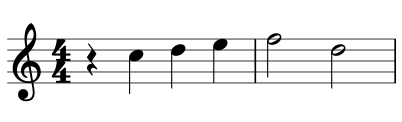
The opening of Beethoven’s Fifth Symphony is a classic example: an eighth rest (UK: quaver rest) on the downbeat, then the three short notes.
Comparison table
| Beginning | Where does the first note enter? | First measure | Example |
|---|---|---|---|
| Thetic (downbeat) | On the strong beat (beat 1) | Complete | Twinkle, Twinkle, Little Star |
| Anacrusic (pickup) | At the middle of the measure or later, before the strong beat | Incomplete (the anacrusis) | Happy Birthday |
| Acephalous (off-beat after a rest) | After a rest on the strong beat, before the middle of the measure | Complete (with an initial rest) or incomplete | Beethoven’s Fifth Symphony |
The other trait that defines a phrase is how it ends: on a strong beat or on a weak beat. To review which beats are strong and weak in each meter, see how to analyze a measure.
To practice, there is an exercise on telling thetic, anacrusic and acephalous beginnings apart from the first two measures of a melody, with three levels and a PDF worksheet.