
A pickup, or anacrusis, is the note or group of notes that come before the first strong beat of a phrase, on a weak part of the measure (UK: bar). It is the lead-in with which many melodies start before reaching the first accent. It is also called an upbeat. The word comes from the Greek anákrousis, "push upward".
What is a pickup?
Compare the same melody starting on the strong beat (with no pickup, a downbeat start) with another that starts with a pickup:
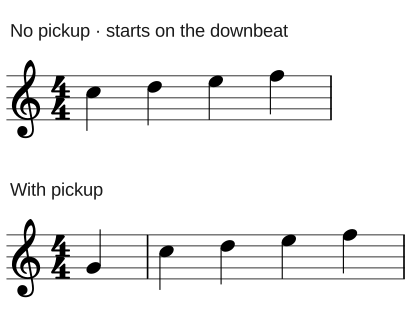
A pickup creates a sense of forward motion and prepares the entrance. For a conductor or a singer, it is the upward gesture (the Italian levare) in which you take a breath just before the accent.
How a pickup is written
When a piece starts with a pickup, the first measure is incomplete: it contains only the pickup notes, not a full measure. This is not a mistake: the missing time is made up at the end. The time signature does not change: a piece in 3/4, 4/4 or 6/8 keeps exactly that time signature even if it starts with a pickup.
Many people search for a "pickup measure time signature", but there is no type of meter with that name. The correct way to say it is that the piece starts with a pickup, that is, before the first strong beat.
How the last measure is completed
This is the key rule: the pickup and the last measure share one full measure between them. If the pickup lasts 1 beat, the final measure has the remaining 3 beats; together they add up to one whole measure. So when you add them, the count works out:
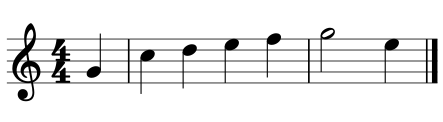
Some editions, for editorial reasons, write the last measure in full instead of shortening it. But the usual practice, and the one taught in theory classes, is to split the measure between the pickup and the ending.
To review which beats are strong and weak in each meter, see how to analyze a time signature.
Example: "Happy Birthday"
Happy Birthday is the perfect example. The first two notes, on the syllables "Hap-py", are the pickup: a dotted eighth note (UK: dotted quaver) and a sixteenth note (UK: semiquaver) on a weak part of the measure. The melody does not reach the first strong beat, the one at the start of the first full measure, until the syllable "Birth-".
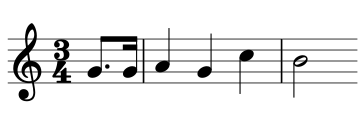
Notice that the last measure is left open, with no closing bar line: the excerpt stops in the middle of the phrase, so that measure is incomplete, and leaving it open shows that the melody continues.
Other famous examples
Pickups appear in classical, popular and traditional music, partly because the lead-in makes a melody feel more natural to sing. Some well-known examples:
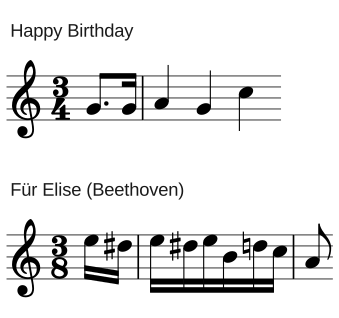
- Happy Birthday and Auld Lang Syne (traditional)
- Für Elise, by Beethoven
- La Marseillaise (the French national anthem)
Pickup, syncopation and off-beat notes
People often confuse them, but they are different things. A pickup is where the melody starts (before the first strong beat). A syncopation is a sound that starts on a weak part and is held across the next strong beat. Off-beat notes are sounds on a weak part with a rest on the strong beat. A pickup also happens only at the beginning, while syncopation and off-beat notes can appear anywhere.