
The ending of a musical phrase can fall on a strong beat or on a weak beat of the measure (UK: bar). Depending on where the last note falls, we speak of a strong-beat ending or a weak-beat ending. It is the other side of a phrase, together with its beginning.
Strong-beat ending
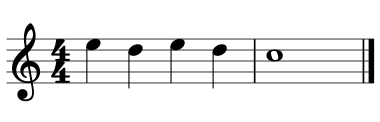
The phrase ends with its last note on a strong beat (an accented one). It gives a feeling of firm, final closure, like a full stop. It is the most common ending in marches, hymns and a large part of popular music.
Weak-beat ending
The last note falls on a weak beat, after the accent. The result is a softer, suspended, “in the air” closing, very common in the waltz and in much Romantic-era music.
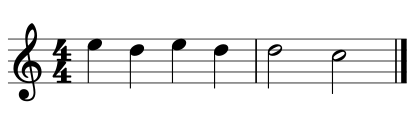
What matters is not how long the last note lasts, but on which beat it starts. A long or a short note can be a strong or a weak ending; what decides it is whether it begins on the accent or after it.
How to tell whether a phrase ends on a strong or weak beat
- Find the last measure of the phrase.
- Look at which beat the last note starts on (not how long it lasts).
- If it starts on a strong beat, it is a strong-beat ending.
- If it starts after the strong beat, it is a weak-beat ending.
If you are unsure which beats are strong or weak, review the rhythmic accent of the measure.
Terminology: masculine and feminine endings
In English-language theory these endings have traditionally been called masculine (on a strong beat) and feminine (on a weak beat). The terms are borrowed from poetry and are still widely used, for example in the study of phrase rhythm and of Classical-era melodies. They are only labels: they say nothing musical about the sound itself. Many teachers prefer the plain descriptions strong-beat ending and weak-beat ending, which are clearer and are used on this site. Spanish-language texts also use the technical terms íctico (ending on the ictus, the strong beat) and posíctico (ending after the ictus); these are rare in English.
Comparison table
| Ending | Where does the last note fall? | Feeling | Typical use | Traditional name |
|---|---|---|---|---|
| Strong-beat | On the accent (strong beat) | Firm conclusion | Marches, hymns, popular music | Masculine ending |
| Weak-beat | After the accent | Soft, suspended closing | Waltz, Romantic-era music | Feminine ending |
Rhythmic ending and cadence are not the same
This ending describes the rhythm (on which beat the last note falls). It must not be confused with the cadence, which is the harmonic ending: the chord progression (V–I, IV–I…) that closes the phrase. A phrase has both at once: a rhythmic ending, strong or weak, and a harmonic ending, its cadence.
To practice, there is an exercise on telling strong-beat and weak-beat endings apart from the last two measures of a melody, with three levels and a PDF worksheet.