
Being able to calculate an interval, that is, to give a name to the distance between two notes, is one of the first skills in music theory. Here is a two-step method that always works, with worked examples and a reference chart. If you need to review the theory first, see the page on musical intervals.
Every interval has a number and a quality
To name an interval you need two pieces of information:
- The number (2nd, 3rd, 4th, 5th…): how many note names it spans.
- The quality (major, minor, perfect, augmented or diminished): its exact size in whole steps and half steps (UK: tones and semitones).
For example, a “Major 3rd” or a “Perfect 5th”. Let’s take each step in turn.
Step 1: count the number
Count the letter names from the lower note up to the upper note, including both. Ignore sharps and flats for now: C♯ and C count the same.
From C to G: C(1) – D(2) – E(3) – F(4) – G(5) → a 5th. From E up to C: E(1) – F(2) – G(3) – A(4) – B(5) – C(6) → a 6th.
⚠️ A common mistake is to count the “steps” between the notes instead of the notes themselves. You count the notes, which is why a unison is 1 and an octave is 8.
Step 2: find the quality
Now count the exact distance in half steps (UK: semitones) and compare it with this chart of the intervals within an octave:
| Half steps | Interval | Example |
|---|---|---|
| 0 | Perfect unison | C–C |
| 1 | minor 2nd | E–F |
| 2 | Major 2nd | C–D |
| 3 | minor 3rd | D–F |
| 4 | Major 3rd | C–E |
| 5 | Perfect 4th | C–F |
| 6 | Augmented 4th / Diminished 5th (tritone) | F–B |
| 7 | Perfect 5th | C–G |
| 8 | minor 6th | E–C |
| 9 | Major 6th | C–A |
| 10 | minor 7th | D–C |
| 11 | Major 7th | C–B |
| 12 | Perfect octave | C–C |
The golden rule of qualities: 2nds, 3rds, 6ths and 7ths can be major or minor; unisons, 4ths, 5ths and octaves are perfect. Make a perfect interval a half step larger and it becomes augmented; make it a half step smaller and it becomes diminished. In the same way, a major interval made a half step larger is augmented, and a minor interval made a half step smaller is diminished.
Worked examples
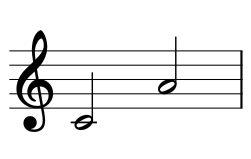
C → A. Step 1: C-D-E-F-G-A = 6 notes → a 6th. Step 2: 9 half steps → Major 6th.
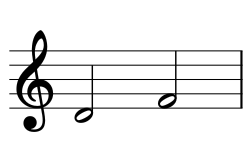
D → F. Step 1: D-E-F = 3 notes → a 3rd. Step 2: 3 half steps → minor 3rd.
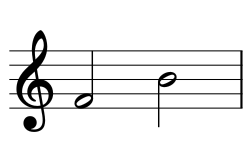
F → B. Step 1: F-G-A-B = 4 notes → a 4th. Step 2: 6 half steps (one more than a perfect 4th) → Augmented 4th (the famous tritone).
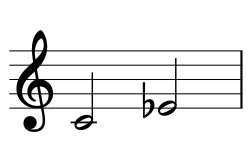
C → E♭. Step 1: C-D-E = a 3rd (the flat does not change the number). Step 2: 3 half steps → minor 3rd.
Useful shortcuts
- Memorize the “natural” intervals above C (C–D Major 2nd, C–E Major 3rd, C–F Perfect 4th, C–G Perfect 5th, C–A Major 6th, C–B Major 7th). They are your reference for comparing other intervals.
- If an interval is larger than an octave, subtract 7 from its number to reduce it: a 9th is a 2nd plus an octave. This is covered in simple and compound intervals.
- To invert an interval (put the lower note on top), the number and quality change in a predictable way. See interval inversion.
- Two notes that sound the same but are spelled differently (C♯ and D♭) form intervals of the same size with different names. They are enharmonic notes.
- Depending on how they sound together, intervals are also classified as consonant and dissonant.
Once you master the calculation, practice with the interval exercises and learn the difference between harmonic and melodic intervals.