
The main division of time signatures is between simple and compound meter (UK: simple and compound time). There is only one difference: how each beat is divided. In simple meter, each beat divides into two equal parts. In compound meter, each beat divides into three.
To train your ear, try the listening exercise recognize the time signature by ear: a melody plays and you choose between 2/4, 3/4, 4/4, 6/8, 9/8 and 12/8.
What is simple meter?
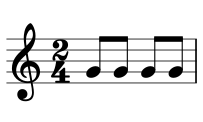
In simple meter, each beat is divided into two equal parts (a binary subdivision). The beat unit is an undotted note value: the quarter note (UK: crotchet) in 2/4, 3/4 and 4/4, the half note (UK: minim) in 3/2, the eighth note (UK: quaver) in 3/8. The most common simple meters are 2/4, 3/4 and 4/4.
What is compound meter?
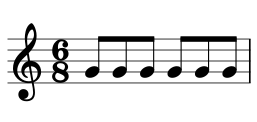
In compound meter, each beat is divided into three equal parts (a ternary subdivision). The beat unit is always a dotted note, because only a dotted note divides naturally into three. The most common compound meters are 6/8, 9/8 and 12/8.
How to tell whether a meter is simple or compound
There are two quick ways to tell, just by looking at the time signature:
- By the top number. If the top number is 2, 3 or 4, the meter is simple. If it is 6, 9 or 12, the meter is compound (these are three times 2, 3 and 4).
- By the beat unit. If each beat is an undotted note (quarter, half, eighth), the meter is simple. If each beat is a dotted note (dotted quarter, dotted half), it is compound.
Chart of simple and compound meters
Every compound meter has a simple "twin" with the same number of beats and the same accent pattern. Only the subdivision changes:
| Beats | Simple meter | Compound meter | Accents |
|---|---|---|---|
| 2 | 2/4 | 6/8 | Strong – weak |
| 3 | 3/4 | 9/8 | Strong – weak – weak |
| 4 | 4/4 | 12/8 | Strong – weak – medium – weak |
The full accent hierarchy is explained in accents in simple meters and accents in compound meters.
The case of 3/8: watch the bottom number
A common mistake is to think that any meter with an 8 on the bottom is compound. It is not. What makes a meter compound is the top number, not the bottom one. 3/8 has an 8 on the bottom but is simple, because its top number is 3: three eighth-note beats, each dividing into two.
How to practice the difference
The best way to feel the difference is to hear a simple and a compound meter one after the other. On the online metronome you can switch between 2/4 (duple) and 6/8 (compound duple) and notice how the character changes. You can also use the analyzing time signatures guide to identify the type of meter in a score.