
When you look at the sheet music of a modern song, symbols like C, Am, G7 or Cmaj7 appear above the staff (or on a lead sheet). These are chord symbols, a quick system for writing chords with letters and numbers. Here you will learn to read them from start to finish.
The letters are the notes
Chord symbols use the letter names of the notes: each letter is one note. If you learned the fixed-do names (Do, Re, Mi… used in Spanish-, French- and Italian-speaking countries), this is the equivalence:
| A | B | C | D | E | F | G |
|---|---|---|---|---|---|---|
| La | Si | Do | Re | Mi | Fa | Sol |
So C is a chord whose root is C, G is one whose root is G, and so on. Sharps and flats are added with ♯ and ♭ (in plain text you will often see # and b): F♯ is F sharp and B♭ is B flat.
The basic rule: a letter alone is major, “m” means minor
A letter on its own means a major chord; with a lowercase m after it, the chord is minor.
- C = C major (C–E–G)
- Cm = C minor (C–E♭–G)
- Am = A minor · G = G major
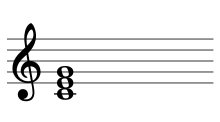
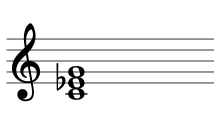
You will also see Cmin or C− for minor. They all mean the same thing. A capital M is sometimes used for major (CM7 = Cmaj7), so pay attention to the case.
Augmented and diminished
- C+ or Caug = augmented chord (C–E–G♯)
- C° or Cdim = diminished chord (C–E♭–G♭)
The numbers: seventh chords
A number adds one more note to the chord. The most common is 7, which on a major chord gives the dominant seventh chord. These are the five main seventh chords:
| Symbol | Chord | Notes (on C) |
|---|---|---|
| C7 | Dominant seventh | C–E–G–B♭ |
| Cmaj7 · CΔ7 | Major seventh | C–E–G–B |
| Cm7 | Minor seventh | C–E♭–G–B♭ |
| Cm7♭5 · Cø | Half-diminished seventh | C–E♭–G♭–B♭ |
| C°7 · Cdim7 | Diminished seventh | C–E♭–G♭–B♭♭ (sounds like A) |
Note that a plain 7 always means a minor seventh above the root (B♭ above C). For a major seventh (B above C) the symbol must say maj7.
Suspended and added notes
- Csus4: the 3rd is replaced by the 4th (C–F–G); Csus2 replaces it with the 2nd (C–D–G). A plain Csus usually means sus4.
- C6: a major chord with an added 6th (C–E–G–A).
- Cadd9: a major chord with an added 9th and no 7th (C–E–G–D).
- C9, C11, C13: dominant seventh chords with higher extensions. C9 includes the 7th (C–E–G–B♭–D), unlike add9. With maj or m in front (Cmaj9, Cm9), the 7th is major or minor accordingly.
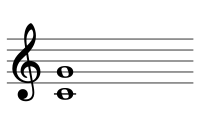
- C5 (power chord): only the root and the 5th, with no 3rd (C–G). Without a 3rd it is neither major nor minor; it is the signature chord of rock and distorted electric guitar.
Slash chords (added bass note)
A slash shows which note goes in the bass, which may not be the root. It is a way of writing inversions in chord symbols.
- C/E = a C major chord with E in the bass (first inversion).
- C/G = C major with G in the bass (second inversion).
- D/F♯ = D major with F♯ in the bass (first inversion).
The bass note does not have to belong to the chord: C/D, for example, puts a D under a C major chord.
Summary chart
| Symbol | Meaning |
|---|---|
| C | Major |
| m · min · − | Minor |
| + · aug | Augmented |
| ° · dim | Diminished |
| 7 | Seventh (dominant) |
| maj7 · Δ7 | Major seventh |
| ø · m7♭5 | Half-diminished |
| sus2 / sus4 | Suspended (2nd / 4th) |
| 5 | Power chord (no 3rd) |
| 6 · add9 | Added note (6th / 9th) |
| /X | That note X in the bass |
How to decode any chord in 4 steps
When you meet a symbol you do not recognize, always read it in this order and you will not go wrong:
- The letter (and its accidental) gives you the root: C is C, B♭ is B flat.
- A capital letter alone, or with “m”? This decides whether it is major or minor. Here you also look for + (augmented) or ° (diminished).
- Is there a number or “maj”? (7, maj7, 6, 9…) Add that note to the chord.
- Is there a slash “/X”? That note goes in the bass.
Example: Dm7/F → (1) D, (2) minor, (3) with a minor 7th, (4) with F in the bass. The reverse is also useful: what does not appear tells you something too. No “m” means major, and no number means a simple triad.
An example
The sequence C – Am – F – G7 reads: C major, A minor, F major and G dominant seventh. It is one of the most widely used progressions in pop music. To understand why these chords fit together so well, review the scale degrees and the cadences.
With this you can already decode most lead sheets. If you want to learn how each chord is built, you will find all the detail in musical chords.